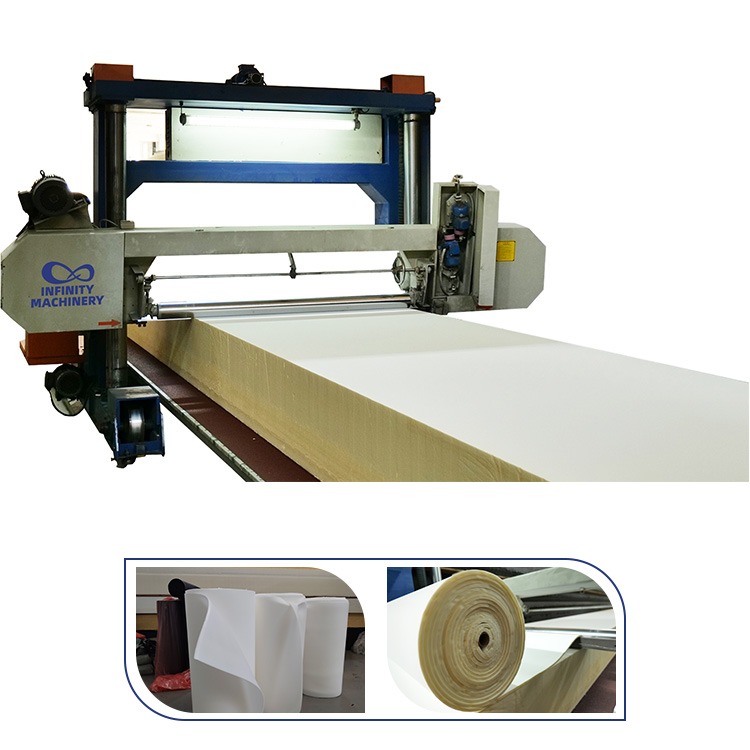
The foam mattress slicer is the machine that turns the block into the layers, and the double horizontal blade is the design that keeps the layers smooth on the big blocks. The single blade cuts the block in the one long pass, the long blade flexes under the load, the flex grows with the block length and the long cut leaves the waviness on the slice surface, and the mattress layer that comes off the wavy slice carries the uneven thickness that the quilting and the assembly inherit. The double blade answers the problem with the two-step pass: the first blade makes the rough cut that removes the bulk and sets the approximate thickness, and the second blade follows at the exact offset to make the finish cut on the already-supported surface, so the finish pass works against the flat reference instead of the flexing span; the double pass is the tolerance design for the long block. The tolerance math is the business case: the slice tolerance target under one millimeter holds the mattress layer thickness, the consistent layer feeds the quilting with the even loft and the even loft saves the material and the rework that the wavy slices cause. This guide walks the single-blade waviness problem, the double-blade pass sequence, the tolerance math and the machine cases. The IF-LT1650/2450 Horizontal Long Track Foam Cutting Machine, the IF-YX01/YX02 Profile Sponge Cutting Machine and the Foam Boring Machine are the machine cases this guide maps.
The blade question of the foam slicer starts with the physics of the long cut, and the physics explains why the single blade cannot hold the tolerance on the big block. The horizontal slicer runs the blade across the block in the long pass, the blade spans the full length and the unsupported span flexes under the cutting load; the first source of the waviness. The flex grows with the length: the three to five meter block runs the blade across the longer span, the longer span bends more under the same load and the wave amplitude grows with the block length; the length is the enemy of the single pass. The blade speed adds the second effect: the high feed rate pushes the blade through the foam, the fast cut deflects the blade and the deflection ripples along the cut; the speed amplifies the flex. The foam itself adds the third effect: the block compresses under the blade pressure, the compression varies with the foam density and the soft foam is pushed ahead of the cut, creating the thickness variation along the slice. The waviness result is the tolerance failure: the slice surface rises and falls by the millimeters, the layer carries the uneven thickness and the quilting inherits the uneven loft; the single blade is the root of the wavy layer.
The table is the waviness map, and the four causes together explain why the single blade cannot hold the smooth tolerance on the long block.
The double-blade pass answers the waviness problem with the two-step cut, changing the physics of the finish pass. The rough cut comes first: the first blade makes the bulk cut at the approximate thickness, removing most of the material and carrying the flex and the waviness of the long span; it takes the punishment the finish pass used to take. The finish cut follows: the second blade runs at the exact offset behind the first, cutting the thin final layer against the surface the first pass already supported, removing the small amount of material with the minimal flex; the precision step. The two-pass geometry is the key: the finish blade cuts near the support instead of across the full unsupported span, so the short distance and the thin layer limit the flex; the geometry is the double-blade advantage. The pass timing completes the design: the rough and the finish blades run in the coordinated sequence, the offset is set to the finish thickness and the feed rate matches the two passes, so the block moves through in the one continuous run; the double pass made automatic. The double-blade result is the smooth slice: the rough cut takes the flex, the finish cut takes the tolerance and the slice leaves with the flat surface under the one millimeter target; the answer to the one-pass waviness.
The table is the two-step plan, and the rough-finish sequence is how the double blade holds the tolerance the single pass cannot.
The tolerance math turns the smooth slice into the measurable line value, following the thickness, the material and the rework. The thickness consistency is the first number: the slice tolerance under the one millimeter holds the mattress layer at the designed thickness, stacking into the even mattress and the comfort rating the product promises. The material saving is the second number: the wavy slice must be sanded or trimmed to the flat surface, and the wavy block yields fewer usable layers per block; the smooth slice saves the material the waviness wastes. The rework saving is the third number: the wavy layer fails the thickness check and goes to the reject, costing the material, the labor and the floor time; the smooth slice removes the rework stream. The quilting effect is the fourth number: the consistent layer feeds the quilting machine with the even loft, quilting without the skipped stitches and the puckering; the smooth slice is the upstream quality the quilting depends on. The tolerance math sums to the layer value: the one millimeter tolerance holds the thickness, saves the material, removes the rework and steadies the quilting, and the four effects together justify the double-blade machine on the big block; the math is the business case for the upgrade.
Consistencia de grosor: la tolerancia bajo 1 mm mantiene la capa del colchon en el grosor disenado | Ahorro de material: la capa ondulada se lija o recorta, el bloque ondulado rinde menos capas | Ahorro de retrabajo: la capa ondulada falla el control de grosor y va al rechazo | Efecto de acolchado: la capa consistente alimenta el acolchado con loft parejo, sin puntadas saltadas
The big-block handling is where the double blade earns its keep, with the length and the density shaping the cutting plan. The length handling is the first case: the three to five meter block runs the double pass across the full span, the rough cut absorbs the flex and the finish cut holds the tolerance near the support, so the long block slices smooth where the single blade waves. The density handling is the second case: the soft foam compresses and pushes ahead, the firm foam resists and carries the vibration, and the double pass handles both because the rough cut stabilizes the surface; the material flexibility of the design. The thickness handling is the third case: the thin slices need the steady surface, the thick slices need the deep cut, and the double pass adjusts the offset and the feed for the profile, so the one machine covers the thin toppers and the thick bases. The block plan completes the handling: the block is staged on the track, the slice plan sets the layer thicknesses in sequence and the double pass runs the plan without the re-clamping, yielding the planned layers in the one continuous run. The big-block handling result is the full-block yield: the length, the density and the thickness variations all pass through the double-blade machine at the smooth tolerance, the production number the slicing plan counts.
Manejo de longitud: el bloque de 3-5 metros corre la doble pasada en el tramo completo, el corte grueso absorbe la flexion y el corte fino mantiene la tolerancia | Manejo de densidad: la espuma blanda se comprime, la firme resiste, el corte grueso estabiliza la superficie | Manejo de grosor: capas finas y gruesas ajustan el offset y la alimentacion | Plan de bloque: el bloque se rinde en capas planeadas en una corrida continua sin re-sujetar
The machine fit matches the slicer to the cutting plan and the product mix, covering the three machine cases of the foam cutting line. The long track machine is the main slicing case: the IF-LT1650/2450 horizontal long track foam cutting machine runs the blade across the full block length, guiding the double pass and cutting the large blocks at the smooth tolerance; the core of the line. The profile machine is the component case: the IF-YX01/YX02 profile sponge cutting machine cuts the shaped profiles and the nested parts, carrying the tolerance into the non-flat cuts and converting the leftover into the shaped products; the second station. The boring machine is the round case: the foam boring machine drills and peels the round foam pieces, producing the round cores and the peeled sheets at the same tolerance; the third station. The fit also covers the line integration: the long track slices the blocks, the profile machine cuts the components and the boring produces the round parts, sharing the block plan and the tolerance standard; the matched line delivers the smooth tolerance.
The implementation plan moves the slicing line to the double-blade standard in six steps, run over the quarter and then maintained on the monthly review. Step 1: the slice audit, measuring the thickness variation across the block, counting the wavy slices and computing the material and rework cost; Step 2: the blade setup, configuring the rough and the finish blades on the long track machine, setting the offset to the finish thickness and tuning the feed to the density. Step 3: the tolerance check, slicing the test block, measuring the first slices along the block and confirming the sub-millimeter target before the run; Step 4: the layer plan, setting the slice thicknesses in sequence and running the whole block in the continuous pass; maximizes the yield per block. Step 5: the line integration, linking the long track slicing with the profile cutting and the boring, sharing the block plan and the tolerance standard; the smooth tolerance. Step 6: the monthly loop, re-measuring the slice variation, tracking the yield against the baseline and adjusting the blades and the plan by the data; keeps the line at the sub-millimeter standard.
The IF-LT1650/2450, the IF-YX01/YX02 and the foam boring machine cover the slicing, the profiling and the round cutting of the foam line, and the six-step plan brings the double-blade tolerance to your block cutting. Contact our foam cutting team for the slice audit template, the double-pass setup guide and the tolerance check protocol.
Contact our foam cutting team today for the double-blade package: the slice audit template, the rough-finish pass setup and the tolerance check protocol that holds the sub-millimeter standard on your big foam blocks.