

1. The Mechanical Limitations of Legacy Flanging Equipment
Equipment ObsolescenceAging manual and semi-automatic flanging units suffer from severe mechanical backlash, unstable loop formation, and excessive needle heat during prolonged shifts. These hidden operational inefficiencies create uneven border joining, frequent thread snaps, and an over-reliance on veteran operators who are increasingly difficult to retain in competitive manufacturing markets.
Engineering Analysis: Mechanical Friction & Wear
- Diagnostic Factor: Worn-out mechanical linkage components introduce slop in the needle-bar drive, resulting in irregular stitch spacing and compromised edge integrity.
- Technical Solution: Modern automatic mattress flanging machines replace mechanical cam drives with high-torque servo motors, eliminating backlash and ensuring butter-smooth over-lock stitch formation.
2. Servo-Driven Multi-Axis Feed Dynamics
Motion ControlSynchronizing the material feeding speed with the sewing head RPM is critical for maintaining uniform over-lock tension across varying mattress panel thicknesses. Traditional belt-driven feeds often slip when encountering dense multi-quilt borders, leading to puckered seams and material bunching.
Operational Parameter: Feed-Rate Synchronization
- Material Insight: Variable fabric densities require dynamic compensation to prevent stretching or compressing knitted border panels during high-speed stitching.
- Technical Solution: Independent servo-controlled feeding rollers automatically adjust linear velocity in real-time, matching the stitch cycle perfectly to eliminate fabric distortion.
3. Precision Corner Turning and PLC Automation
PLC IntegrationThe transition across mattress corners represents the highest risk zone for structural seam failure and aesthetic defects. Standard machinery relies on operator reflexes to slow down and pivot, introducing human error and dimensional inconsistencies into finished bedding assemblies.
Engineering Analysis: Automated Corner Deceleration
- Diagnostic Factor: Manual corner rounding creates irregular radius loops and inconsistent over-lock width, forcing downstream quality rejections.
- Technical Solution: PLC-driven turning arms and optical sensors automatically decelerate the sewing head and execute precise 90-degree corner pivots without operator intervention.
4. Optimizing Non-Woven Tape and Fabric Tensioning
Tension DynamicsFlanging requires the simultaneous feeding, folding, and stitching of non-woven reinforcing strips alongside heavy quilted panels. Without precise tension regulation, the reinforcing strip can skew, leaving raw foam edges exposed and compromising product durability.
Material Property: Edge Reinforcement Mechanics
- Material Insight: Non-woven fabrics exhibit variable elasticity under tension, which can cause edge curling if winding mechanisms are not actively regulated.
- Technical Solution: Integrated adjustable fabric tension devices and automatic winding systems maintain constant web tension from full rolls down to the core.
Recommended Heavy-Duty Flanging Solutions

Features an automated turning arm, PLC touch screen interface, and automatic thread/non-woven cutting for consistent corner radius and maximum efficiency.
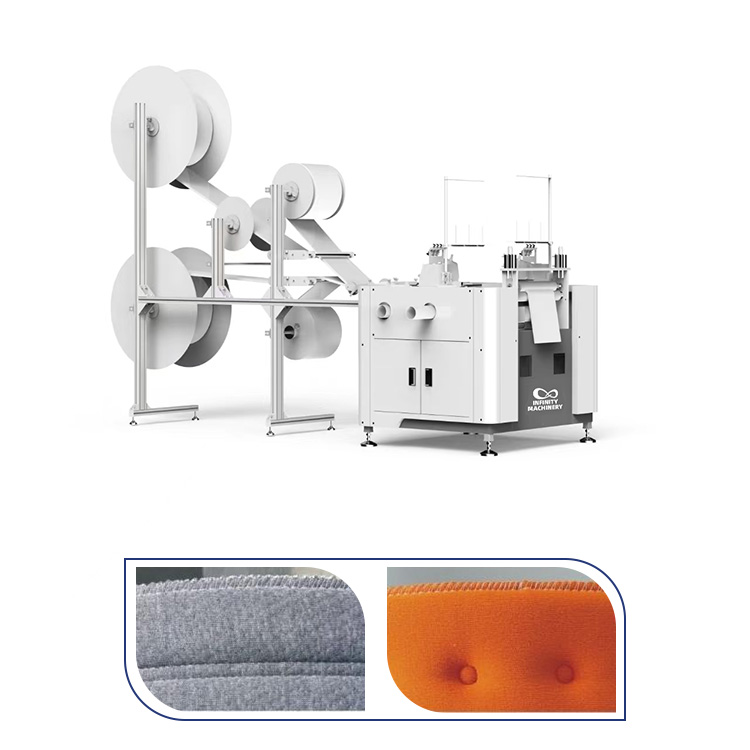
Equipped with direct-driven servo motors controlling both sewing heads, adjustable fabric tension, and robust winding mechanisms for high-speed performance.
5. Direct-Drive Sewing Head Synchronization
Mechanical DurabilityThe elimination of complex overhead belt pulleys and mechanical clutches in favor of direct-drive servo motors has revolutionized industrial sewing longevity. Modern flanging systems operate with fewer moving parts, reducing vibration and thermal degradation during high-speed shifts.
Engineering Analysis: Power Transmission Efficiency
- Diagnostic Factor: Traditional belt drives experience slip and power loss, leading to inconsistent needle penetration force through thick quilted assemblies.
- Technical Solution: Direct-mounted servo motors deliver instant torque directly to the needle bar, ensuring clean, powerful penetration through multi-layer borders without stalling.
6. Mitigating Fabric Puckering and Seam Slippage
Seam IntegritySeam puckering occurs when differential feed rates between the upper presser foot and lower feed dog create localized shearing forces. Over-lock stitching mechanics require precise foot pressure adjustment to accommodate plush pillow-top designs without crushing internal padding layers.
Operational Parameter: Presser Foot Pressure Calibration
- Material Insight: High-loft quilting materials compress unevenly under fixed-pressure feet, resulting in wavy, unprofessional border finishes.
- Technical Solution: Pneumatic presser foot lifting mechanisms with digital pressure regulation allow instant adaptation to varying material thicknesses (up to 35mm-90mm).
7. Maximizing Factory ROI and Plant Scalability
Plant ProfitabilityReplacing slow, labor-intensive legacy equipment with automated over-lock flanging systems transforms factory unit economics. By doubling hourly output per station and slashing material scrap rates, plant owners achieve rapid capital payback while scaling daily bed production.
Operational Parameter: Cost-Per-Bed Reduction
- Diagnostic Factor: High labor overhead and excessive manual handling limit daily factory output and inflate production costs per mattress.
- Technical Solution: Full automation reduces operator headcount requirements per line, transforming a bottleneck workstation into a high-speed profit center.
Strategic Manufacturing Takeaway
Transitioning from legacy mechanical flanging units to advanced, servo-controlled automated systems is no longer optional for competitive bedding manufacturers. By partnering with industry leaders like Infinity Mattress Machinery, plant owners can eliminate production bottlenecks, achieve flawless over-lock seam consistency, and secure long-term factory profitability at scale.
Ready to Upgrade Your Mattress Production Line?
Contact our engineering experts today for custom plant layouts, equipment ROI analysis, and tailored machinery specifications.


