

1. The Hidden Operational Bottlenecks of Legacy Flanging Equipment
Operational BottleneckTraditional mechanical flanging setups rely on complex mechanical clutches, belt linkages, and manual fabric manipulation. These legacy systems lead to frequent slipping, uneven stitch tension, and an unacceptable rate of fabric scrap during corner execution, draining factory profitability.
Operational Impact Analysis
- Root Cause of Inefficiency: Mechanical lag and worn clutch components create synchronization errors between the feeding mechanism and sewing head, resulting in puckered borders.
- Technical Solution: Modern engineering replaces mechanical power trains with synchronized digital controls, ensuring uniform material feed and eliminating slip across all operational speeds.
2. Direct-Drive Servo Integration versus Belt-Driven Limitations
Servo IntegrationThe elimination of external belts and pulleys in favor of direct-drive servo architecture represents a monumental leap in mechanical reliability. Servo integration provides instantaneous torque response, precise needle stopping positions, and drastically reduced thermal output during continuous high-speed production shifts.
Torque and Control Dynamics
- Mechanical Advantage: Direct-drive configurations remove rotational friction points, delivering 100% of motor torque directly to the needle bar and rotary hook system.
- Technical Solution: Programmable servo parameters allow precise adjustments for varying foam and fabric densities, ensuring zero thread breakage even at speeds exceeding 3,000 RPM.
3. Automated Turning Arms and PLC Integration for Consistent Corner Radii
Automation TechnologyAchieving a uniform corner radius on heavy mattress panels traditionally required exceptional operator skill and constant manual intervention. Programmable Logic Controllers (PLCs) paired with automated turning arms execute these complex maneuvers with micrometric precision every single cycle.
Kinematic Precision
- Corner Quality Control: Manual turning introduces variance in corner bunching and tension, whereas automated pneumatic turning arms guarantee exact dimensional repeatability.
- Technical Solution: Integrated PLC touchscreens allow operators to pre-set corner slowdown profiles and turning angles, turning complex multi-step operations into a single automated sequence.
4. Maximizing Shift Throughput and Reducing Labor Headcount
Production EfficiencyLabor shortages and rising payroll costs make operator dependency a severe risk to plant profitability. Modern automated flanging systems drastically reduce the physical burden on workers, allowing a single technician to oversee multiple high-speed production lines with minimal fatigue.
Labor Optimization
- Throughput Multiplier: Automated material clamping, trimming, and corner rotation elevate hourly output by up to 50% compared to semi-automatic legacy benches.
- Technical Solution: By offloading physical handling to automated pneumatic arms and conveyor integration, plants achieve steady, predictable output metrics across all shifts.
Essential Machinery for Scaling Production

Features an automatic turning arm, PLC touch-screen interface, and precise thread/non-woven fabric cutting for consistent corner radius and high-speed execution.
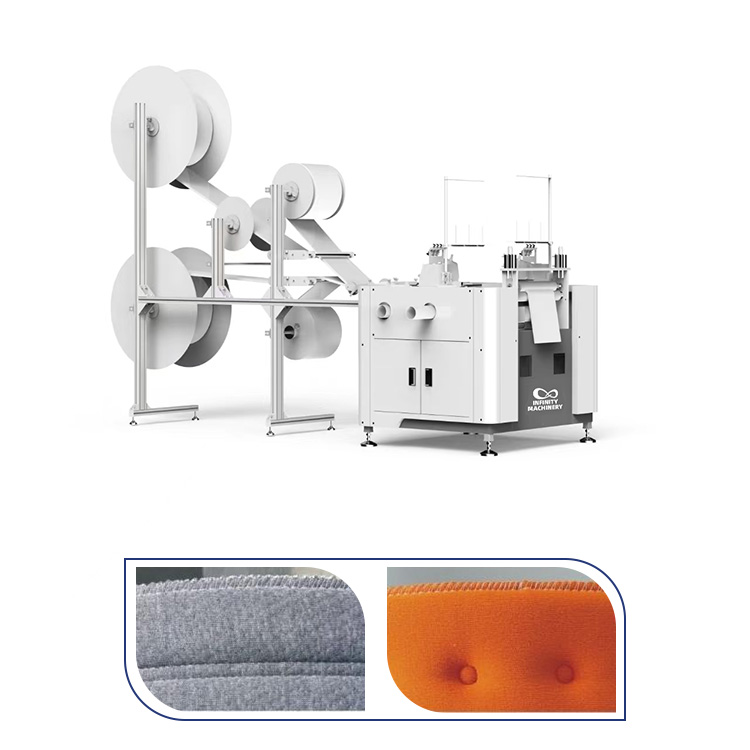
Equipped with direct-driven servo motors controlling both front and back sewing heads, adjustable fabric tension, and robust winding mechanisms for flawless borders.
5. Structural Rigidity and Vibration Dampening in High-Speed Sewing
Mechanical StabilityOperating sewing heads at thousands of RPM generates intense harmonic vibrations that can degrade stitch accuracy over time. Heavy-gauge fabricated steel frames and precision linear guide rails absorb these forces, ensuring long-term structural integrity.
Vibration Control
- Structural Integrity: Lightweight frames flex under high-speed load, causing needle deflection and skipped stitches. Heavy-duty cast and steel chassis maintain strict alignment.
- Technical Solution: Reinforced machine beds combined with imported linear guide rails dampen resonant frequencies, preserving needle drop precision under heavy industrial use.
6. Minimizing Downtime and Simplifying Routine Maintenance Protocols
Maintenance ProtocolUnscheduled equipment downtime is the primary enemy of factory throughput. Modern flanging systems incorporate automated lubrication circuits, self-diagnostic software, and modular component designs that simplify servicing and reduce mean time to repair.
Downtime Reduction
- Maintenance Efficiency: Automated oil supply systems eliminate manual greasing oversights, preventing premature wear on high-speed rotary hooks and needle bars.
- Technical Solution: Integrated electronic error-reporting pinpoints sensor faults or thread breaks instantly, allowing maintenance teams to resolve issues before production stalls.
7. Capital ROI and Labor Optimization in Modern Mattress Plants
Financial ReturnInvesting in automated machinery is fundamentally an exercise in lowering unit costs and securing long-term manufacturing competitiveness. By partnering with established innovators at the Infinity Mattress Machinery Official Website, plant owners achieve rapid capital payback through reduced scrap rates and maximized shift output.
Investment Recovery
- Cost Reduction: Eliminating fabric waste and reducing direct labor requirements cuts production costs per mattress significantly within the first operational year.
- Technical Solution: Scalable automation allows growing facilities to expand daily output without expanding their physical footprint or adding shift personnel.
Executive Summary for Plant Investors
Transitioning from legacy, operator-dependent flanging tables to advanced direct-drive servo machinery is no longer optional for competitive bedding manufacturers. By integrating automated turning arms, precise PLC controls, and robust structural engineering, factory owners secure lower per-bed manufacturing costs, flawless aesthetic consistency, and reliable, high-volume throughput that directly maximizes bottom-line profitability.
Ready to Upgrade Your Factory Line?
Consult with our manufacturing engineers to design a custom automated solution for your plant.


