

1. The Hidden Bottlenecks of Legacy Manual Flanging Operations
Legacy Equipment AnalysisOutdated flanging machines rely heavily on manual guidance and mechanical clutches, creating severe production bottlenecks across the workshop floor. Factory owners face chronic downtime due to frequent thread jams, inconsistent corner tension, and painful dependency on veteran operators who are increasingly difficult to retain.
Operational Bottlenecks
- Mechanical Wear & Operator Dependency: Older mechanical systems suffer from progressive gear slack and require constant manual adjustment by skilled labor to prevent fabric puckering.
- Technical Solution: Modern automated flanging systems utilize closed-loop PLC logic to eliminate manual operator variability, ensuring uniform stitch quality across every shift.
Material Waste
- Fabric & Thread Scrap: Manual feeding misalignment leads to frequent edge tearing and excessive thread wastage during high-speed runs.
- Technical Solution: Upgrading to digital-controlled units drastically reduces scrap rates caused by misaligned non-woven feeding and manual cutting errors.
2. Precision Mechanics: How Servo-Driven Direct Drives Eliminate Slippage
Servo Drive TechnologyTraditional belt-driven sewing heads suffer from speed fluctuations and transmission slip under heavy loads. Implementing direct-driven servo motors provides instantaneous torque response and exact synchronization between the needle and fabric feed rollers.
Torque & Speed
- Direct-Driven Synchronization: Mechanical slippage in belt drives often causes stitch length irregularity when transitioning across thick border quilting zones.
- Technical Solution: Servo control allows the sewing head and rotary components to maintain constant speed ratios, preventing puckering on thick border panels.
Maintenance Reality
- Component Longevity: Brushless servo designs eliminate wearable belts and mechanical clutches, drastically lowering routine maintenance overhead and unexpected workshop stoppages.
- Technical Solution: Direct-drive configurations minimize moving parts, ensuring long-term operational stability and simplified daily lubrication routines.
3. Automated Turning Arms: Accelerating Cycle Times and Reducing Operator Fatigue
Automated HandlingManually flipping and pivoting heavy border panels drains operator energy and limits shift throughput. Integrated turning arms automate the complex transition across corners, allowing plants to achieve continuous high-speed flanging without physical strain.
Kinematic Efficiency
- Corner Acceleration Control: Manual turning introduces inconsistent dwell times and irregular corner radii, degrading the aesthetic standard of the mattress border.
- Technical Solution: Programmable pneumatic turning arms automatically slow down during corner transitions and accelerate on straight edges, optimizing hourly output.
Ergonomics & Safety
- Operator Fatigue Mitigation: Physical handling of bulky mattress panels leads to worker fatigue, repetitive strain injuries, and declining output toward the end of shifts.
- Technical Solution: Automating the handling phase removes repetitive physical stress, leading to sustained productivity throughout high-volume production cycles.
4. PLC Interfaces and Digital Recipe Storage for Zero-Defect Corner Radii
Digital Control SystemsAchieving consistent corner radii on diverse mattress models requires precise coordinate mapping. Modern controllers feature intuitive touchscreens where operators can save specific parameter profiles for rapid changeovers.
Parameter Calibration
- Recipe Management: Frequent changeovers between different mattress thicknesses typically require tedious manual adjustments of guide rails and tensioners.
- Technical Solution: Storing pre-set operational profiles reduces machine setup times to zero when switching between different mattress thicknesses and border widths.
Quality Assurance
- Dimensional Consistency: Manual parameter setting often results in dimensional drift and uneven flange widths across large production batches.
- Technical Solution: PLC-driven coordinate tracking guarantees uniform flange widths and flawless corner rounding across entire production batches.
Recommended High-Performance Flanging Machinery

Features an automatic turning arm, PLC control system with touch screen interface, and automatic thread/non-woven cutting for consistent size and corner radius.
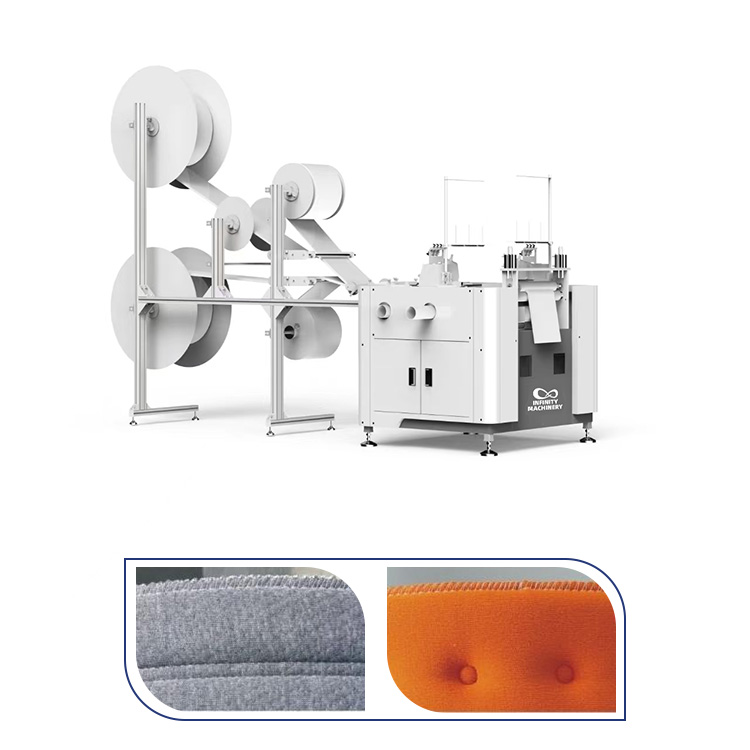
Equipped with direct-driven servo motors controlling both front and back sewing heads, adjustable fabric tension, and reliable winding mechanisms.
5. Integrated Thread and Non-Woven Fabric Trimming Systems
Automated TrimmingPost-sewing cleanup is a notorious labor trap in conventional assembly floors. Built-in pneumatic cutting modules automatically shear excess thread and non-woven fabric instantly upon cycle completion, streamlining downstream processes.
Post-Processing Workflow
- In-Line Shear Precision: Manual trimming with hand scissors introduces bottleneck delays and risks accidental fabric snips that ruin finished panels.
- Technical Solution: Automated blade actuation removes the need for manual scissor trimming, speeding up the hand-off to downstream workstations.
Material Integration
- Non-Woven Feeding Integrity: Loose fabric tails and uneven thread ends create assembly snags during subsequent tape edge operations.
- Technical Solution: Synchronized tensioners prevent fabric bunching during the cutting phase, ensuring clean edge profiles for subsequent tape edge operations.
6. Maximizing Factory ROI: Lowering Labor Headcount and Cost-Per-Bed
Economic ROI AnalysisCapital expenditure on advanced equipment must be justified by tangible unit cost reductions. By integrating efficient Automatic Mattress Flanging Machines into your plant layout, you directly shrink labor headcounts while scaling daily output volumes.
Financial Projections
- Cost-Per-Bed Reduction: High labor overhead and slow cycle times on legacy machines inflate unit costs and compress profit margins.
- Technical Solution: Higher hourly throughput and zero-defect consistency combine to lower manufacturing expenses, delivering rapid payback on machinery investments.
Plant Scalability
- Comprehensive Plant Integration: Isolated machinery upgrades fail to resolve overarching plant bottlenecks if downstream workflows remain sluggish.
- Technical Solution: Modern machinery fits seamlessly into broader Mattress Manufacturing One-Stop Solutions, future-proofing your factory against rising labor costs and market demand spikes.
Securing Long-Term Profitability Through Equipment Upgrades
Replacing slow, legacy manual operations with automated, reliable equipment like Infinity Mattress Machinery is the definitive strategy for reducing cost-per-bed, maximizing output per shift, and securing long-term factory profitability.
Ready to Modernize Your Factory Floor?
Consult with our engineering experts to design a customized automated production layout tailored to your throughput goals.


